If you ask most educated road racing fans how to become a professional racing driver, they will describe a straight line. While oversimplified, you start in karting. If you win consistently at national karting championships (or just have the itch at some point later in life), you might progress to Formula 4. Then, with bigger leaps in skill, luck, funding and commitment, Formula 3. Then Formula 2. Finally, if you are one of the chosen two or three in the world that year, you step into Formula 1.
F1 drivers, like Charles Leclerc and Oscar Piastri, are known for winning at each of these levels and some, like Max Verstappen had an elite karting resume, jumped straight into F3 (winning 10 races in his rookie season), and then bypassed F2 to enter F1, but seat time somewhere in this progression is common.
However, while the “F1 Ladder” is brutal, expensive, and statistically nearly impossible to climb, it is wonderfully easy to understand – a single-file funnel.
Yet most paid professional racing careers today are not found in F1. They are found in the sprawling world of endurance sports car racing, specifically IMSA and the WEC. This is the world known for the 24 Hours of Le Mans, the 24 Hours of Daytona, the 12 Hours of Sebring and nearly a dozen other races spanning the globe.
Unlike the clarity of the F1 ladder, the path to the top class of Le Mans (Hypercar/GTP) can seem like a confusing maze of multi-class racing, “Pro-Am” driver ratings, and fluctuating regulations. To clear the confusion, we need to view the Endurance Ladder with the same structure as Formula 1.
The ladder currently starts professionally at LMP3 (Le Mans Prototype 3). But for a driver coming out of karting or a club car, jumping straight into a prototype is a massive leap. The endurance ladder has its foundational steps, most people just don’t know what they are or where to start. It needs an equivalent to F4 and F3.
Let’s call them “LMP5” and “LMP4.”
While those categories do not officially exist in the rulebook, they should and if you are looking for the most cost-effective, skill-relevant machines to fill those roles, the answer is Radical Motorsport.

Step 1: The “LMP5” – Radical SR3 XXR
The Mission: Mastering Downforce. In the open-wheel world, Formula 4 is the first step out of karts. It is the first time a driver experiences “slicks and wings.”
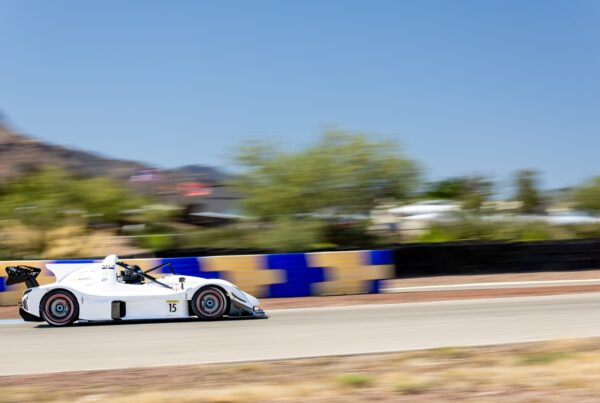
The Radical SR3 is the perfect “LMP5” equivalent, offered in 201 hp, 1,340 cc and 232 hp, 1,500 cc RPE Hayabusa-based configurations. It is a lightweight, high-downforce prototype. Crucially, it uses a tubular steel spaceframe chassis rather than a carbon tub.
The Safety and Cost Reality: The new SR3 XXR features a “Halo-inspired” Cockpit Safety Structure that offers exceptional head protection similar to other single-seaters. However, because the chassis is steel, it absorbs energy differently. More importantly for a self-funded driver, it is repairable.
A minor crash in a carbon fiber F4 car often means writing off the tub, a massive expense that can end a season instantly. A similar impact in an SR3 usually results in bent tubes that can be fixed for a fraction of the price. This removes the “fear tax,” allowing drivers to push the limits and learn the car’s behavior without worrying that a single mistake will bankrupt their campaign.

Step 2: The “LMP4” – Radical SR10 XXR
The Mission: Turbo Torque and Traffic Management. If the SR3 is the classroom, the SR10 is the finishing school. The jump from a 232 hp SR3 to LMP3 is significant in outright speed, but the more meaningful shift lies in engine character. Modern endurance racing increasingly relies on turbocharged power, particularly in the Hypercar ranks. The SR10’s 425 hp, 2.3-liter turbocharged Ford EcoBoost – developed and sealed by RPE – introduces drivers to that same forced-induction discipline.
The Turbo Lesson: Driving a turbocharged car demands a different approach than a naturally aspirated SR3 or F3. Torque arrives earlier and with greater intensity, requiring precise throttle modulation on corner exit to preserve traction. In this way, the SR10 mirrors the power delivery common across contemporary endurance machinery.
Traffic University: Radical Cup often places SR3 and SR10 cars on track together, creating true multi-class racing – the defining dynamic of Le Mans. An SR10 driver spends much of the race managing traffic, judging closing speeds, and committing to passes off-line. Developing this spatial awareness and decisiveness is critical; it is a discipline many open-wheel drivers must learn when transitioning to prototypes.
The Radical Advantage: Why Not Ligier or Revolution?
There are other “entry-level” prototypes on the market, notably the Ligier JS P4 or Revolution Race Cars. While these are impressive pieces of engineering, they often lack the critical ecosystem needed for a developing career.
The primary value of a feeder series is the competition. You cannot learn racecraft by lapping alone. Radical boasts the largest grids in the world, ensuring that you are constantly fighting in a pack, attacking, and defending. Competing “proto-lite” series often struggle to fill their fields, leaving drivers with little to no direct wheel-to-wheel experience.
Furthermore, there is the issue of liquidity. To climb a ladder, you eventually need to sell your current car to fund the next one. Because Radical is a global standard with high demand, the market is liquid; you can sell an SR3 or SR10 relatively quickly. Niche manufacturers often suffer from a stagnant resale market, leaving you stuck with an asset you cannot offload when it is time to graduate to LMP3.

Step 3: LMP3 (Le Mans Prototype 3)
The Mission: The Proving Ground. This is the official entry into the big leagues. Regardless of chassis manufacturer, an LMP3 is a serious, thoroughbred racing machine featuring a carbon-fiber chassis and up to 470 hp. It carries greater mass and torque than an SR10, amplified by higher sustained aero load, different gearing, greater braking energy, and increased stability at speed. It serves as the standard platform for IMSA and European Le Mans Series feeder categories.
Because the car is so capable and the competition is professional, it demands respect. This is a high-stakes environment where you are expected to perform, not learn fundamental techniques. If you have done your homework in the “LMP4” Radical SR10, the transition to LMP3 is natural. You are simply applying your skills in a faster, more sophisticated machine.

Step 4: LMP2 (Le Mans Prototype 2)
The Mission: The High-Speed Showcase. LMP2 is the final test before the top tier. These cars utilize a spec 4.2-liter Gibson V8 producing up to 600 hp and generate immense aerodynamic downforce. They are physically demanding and extraordinarily fast.
This is the category where factory teams from Porsche, Ferrari, and Cadillac look for their next drivers. If you can be fast and consistent here, you are ready for the top step.

Your Partner for the Entire Journey: Crown
Crown is built for drivers who want a real plan, not random track days. We are not just selling seat time, we are building a progression, with the same people, the same standards, and the same accountability from the first laps to the first serious grid. And to make sure the guidance stays grounded in the real motorsport world, the Let’s Go Racing Guide is curated with the editors of RACER, the same RACER Magazine and Racer.com voice that has covered this sport for decades. The goal is simple: remove the chaos, tighten the learning curve, and give you one team that can carry you from “I want to do this” to “I’m ready for the next level.”
The hardest part of climbing a racing ladder is usually the logistics. You often need a karting team, then a separate formula car team, and eventually a prototype team.
Crown changes that dynamic.
By leveraging a powerful partnership with Radical Motorsport and utilizing the premier facilities at Apex Motor Club and Inde Motorsports Ranch, Crown offers a seamless progression under one roof.
We can guide you from your very first track days in a Radical SR3 (“LMP5”), help you master high-speed boost management in an SR10 (“LMP4”), and provide the race support and engineering required to compete in professional LMP3 and LMP2 machinery.
You don’t need to navigate the maze alone. You just need to drive.