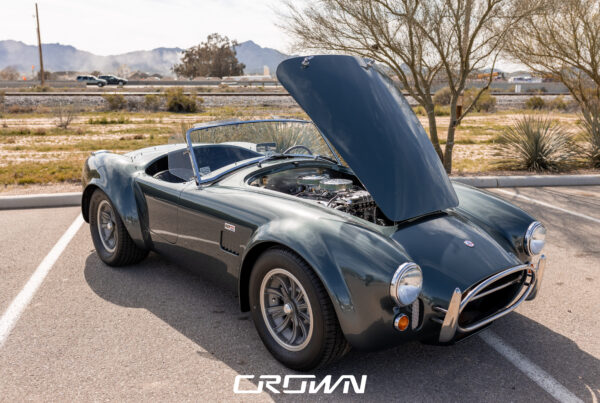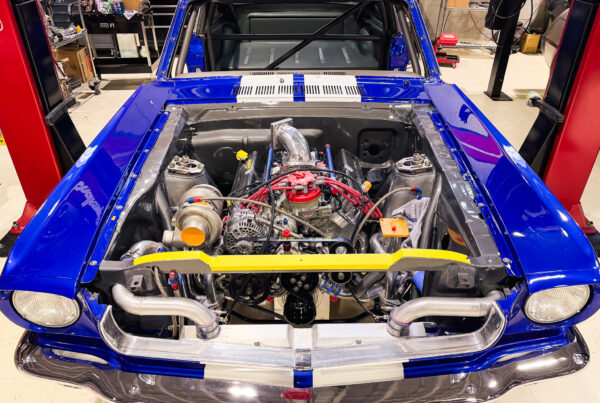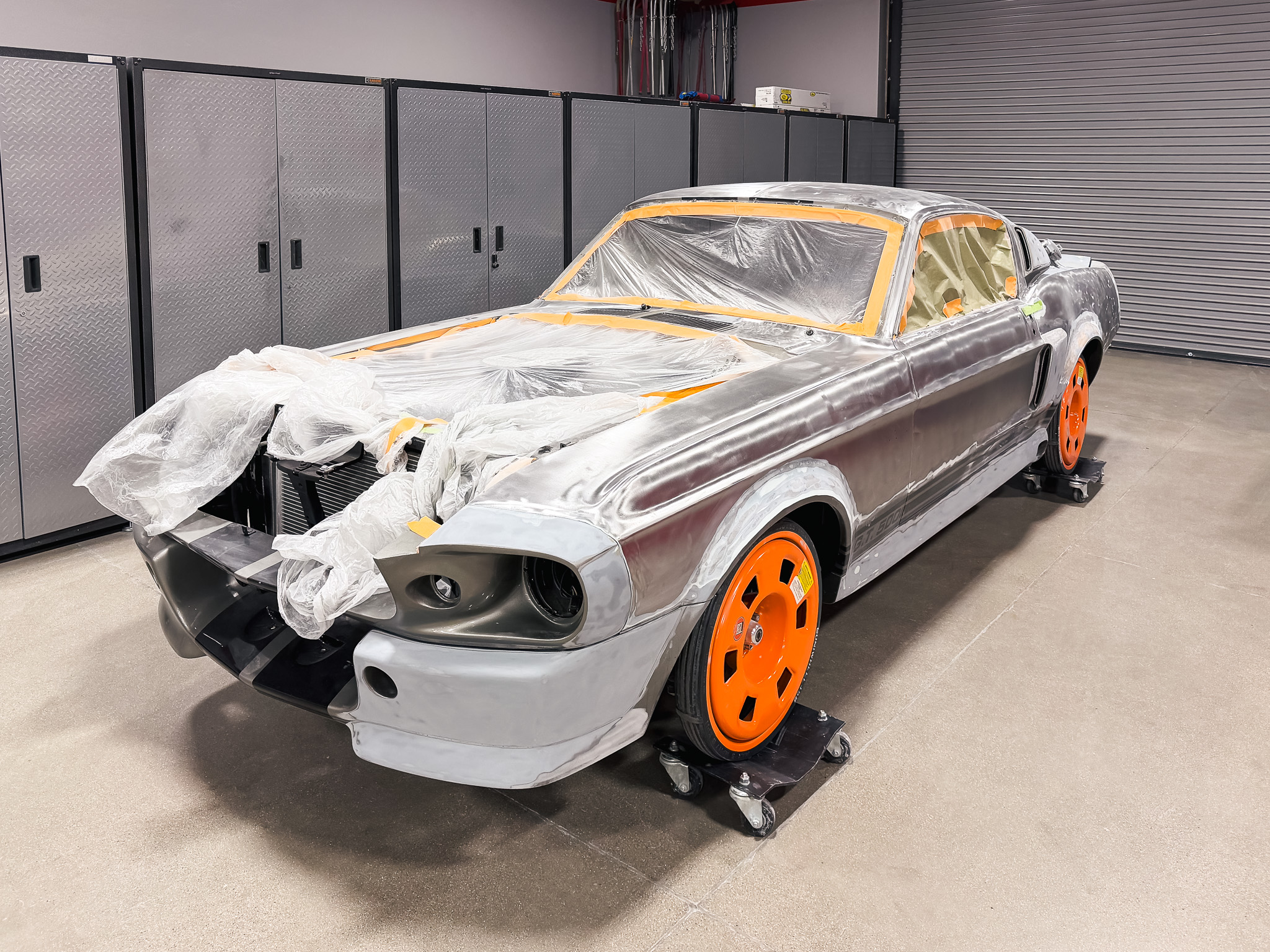
The shop is in a heavy mid-build phase right now. Most projects have moved past teardown and fabrication and are now deep into mechanical assembly, fitment, and systems integration. Engines are in chassis, driveline geometry is established, and the work has shifted toward plumbing, wiring, and finishing. It’s the stage where the big decisions are already made, and what remains is execution.
The most technically involved project in the shop right now is the 1965 Shelby GT350.
This build is centered around a 347 small block Ford stroker paired with twin 66mm turbochargers. The engine is fully installed, and the front accessory system is complete with the belt drive mounted and aligned. At this stage, the focus is on induction and support systems. The throttle body and upper intake are being installed along with vacuum routing and charge plumbing.
Turbochargers are scheduled to go on next week, which will complete the primary forced induction system. Once that is finalized, wiring will begin, estimated within the next two weeks. From there, the car will move into ECU integration, fuel system setup, and initial startup. The foundation is in place. What remains is system completion and calibration.
Next is the 1970 Chevrolet Camaro, which has already crossed a major threshold.
The engine and transmission are installed, and the car is at a complete run, stop, and steer condition. Steering, braking, and driveline are all functional. That’s the point where the build becomes predictable.
From here, the car is leaving the shop to return to a separate body shop to complete exterior work. That includes full panel installation and alignment, doors, fenders, hood, and glass, followed by final paint. Once complete, it will return for final assembly. Remaining work will include interior installation, wiring cleanup, system checks, and delivery prep.
The 1967 Mustang is a different type of project.
It’s built around a modern 2.3L EcoBoost platform rather than a traditional drivetrain. The engine is installed, and current work is focused on completing the wiring harness and ensuring full system integration within the older chassis.
Next steps are cooling and exhaust. The radiator will be installed, followed by exhaust fabrication and routing. This is a clean integration build, less fabrication-heavy, but dependent on correct execution to avoid issues down the line.
Alongside it is the 1967 Austin London Taxi (FX4 platform).
These were originally built as commercial vehicles with a separate chassis, independent front suspension, and extremely tight steering geometry designed for urban maneuverability. Projects like this are not linear. They are handled system by system, solving structure, driveline, and integration challenges as they come up.
Progress is steady. The platform is simple, but adapting it properly requires careful planning to maintain reliability.
Also in the shop is the 1968 Mustang “Eleanor” build, which is currently undergoing a full correction phase.
A detailed inspection identified widespread issues across paint, fitment, and mechanical details. Paint defects include overspray, cracking around the fastback scoops, bubbling at the driver’s door, inconsistencies around the rear panel, and defects at window trim. Based on condition, spot repair is not viable. The plan is a full repaint taken down to correct base layers and rebuilt to a show-quality finish.
Mechanical corrections are being addressed in parallel. These include exhaust tip alignment at the rocker, traction bar bushings, rear axle venting, and underside cleanup. Additional work includes brake line routing corrections, minor oil seepage at the pan plug, and cleanup of exposed wiring and grounding.
The engine bay will be refined with panel work, wiring tuck and loom, and blacked-out finishing. Interior work includes rear seat latch correction, panel refinishing, and overall fitment improvements. All glass will be replaced due to wear and damage. This is a full rework project estimated in the 600–1000 hour range depending on final scope.
In addition to the primary builds, there are several smaller projects moving through the shop.
A Daytona, a Firebird, and a Land Rover owned by a former NFL player are all currently in-house. These projects are more contained in scope but still require full mechanical and cosmetic attention as they move through their respective stages.
There is also an E36-based Lemons race car in the shop.
Built on the BMW 3 Series (E36) chassis, these cars are known for their simplicity, balanced rear-wheel-drive layout, and multi-link rear suspension, which makes them a common choice for grassroots racing and endurance formats. This particular build follows that same philosophy. Work here is focused on reliability, serviceability, and keeping the car consistent under race conditions rather than refinement. It’s a purpose-built car, and the work reflects that.
Alongside everything else, the shop continues with Radical prep.
This work runs continuously in the background. It’s not fabrication-heavy, but it requires precision. Setup, inspection, and detail work ensure the cars are mechanically sound and ready for track use at any time. It’s routine, but it’s critical.
Overall, the shop is in the phase where most unknowns are gone. Engines are in place. Systems are defined. What remains is fitment, wiring, and final execution.
That’s where builds are either finished properly… or not.