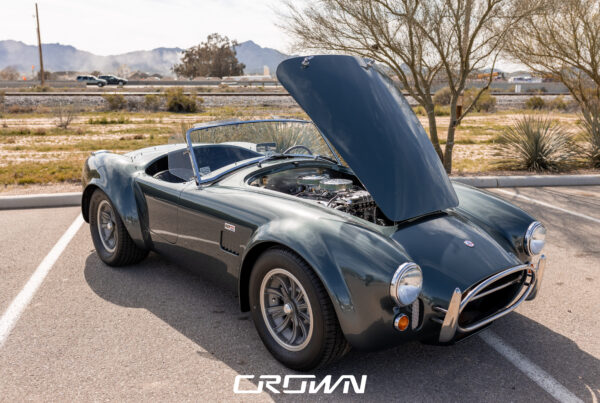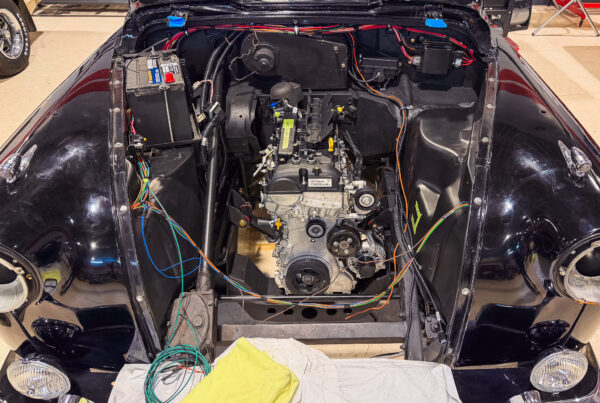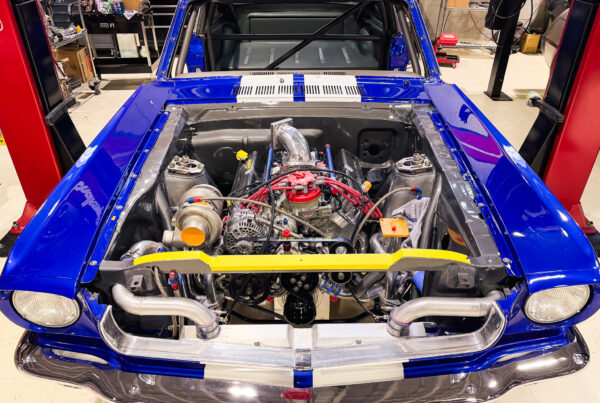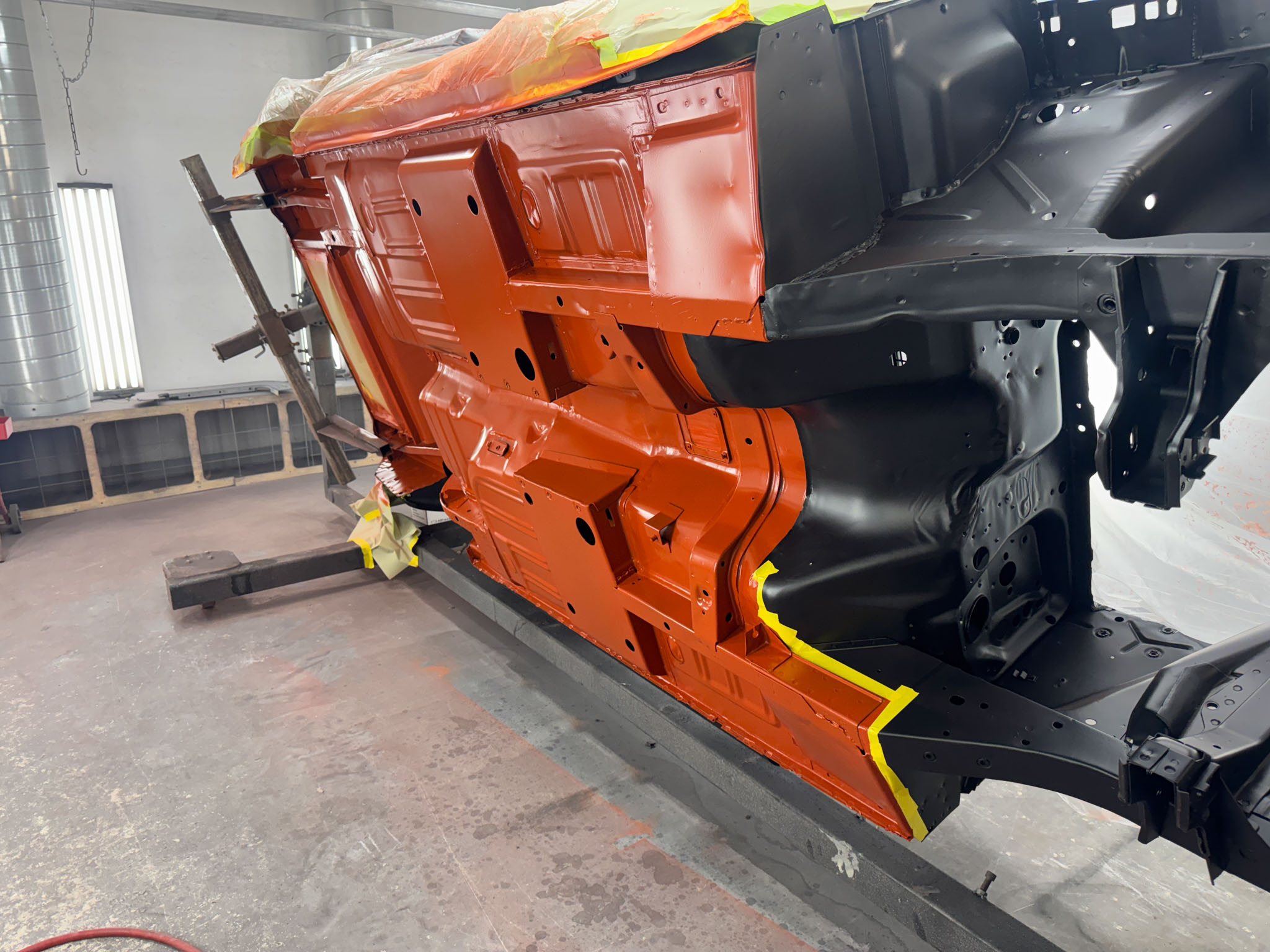
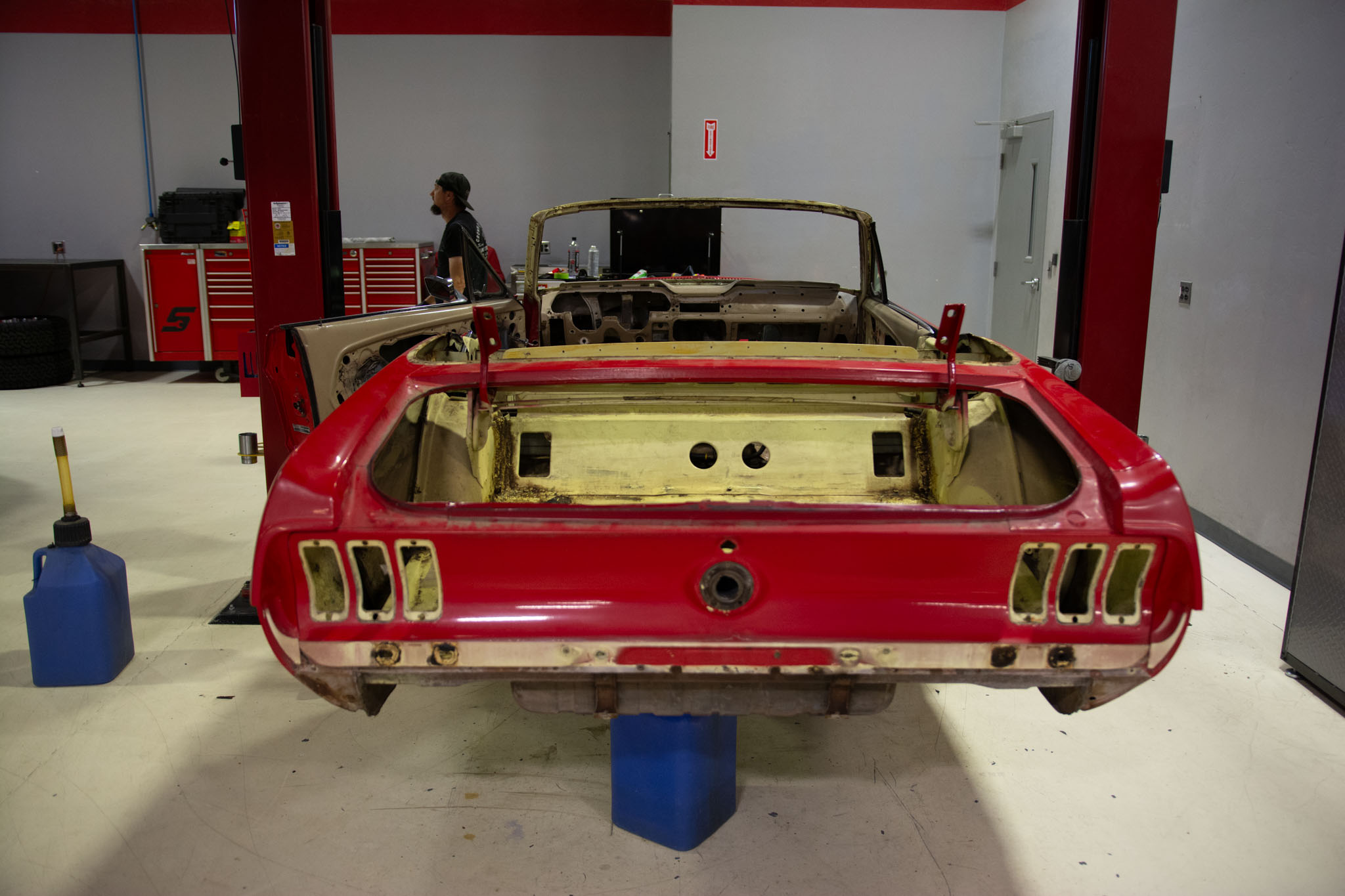
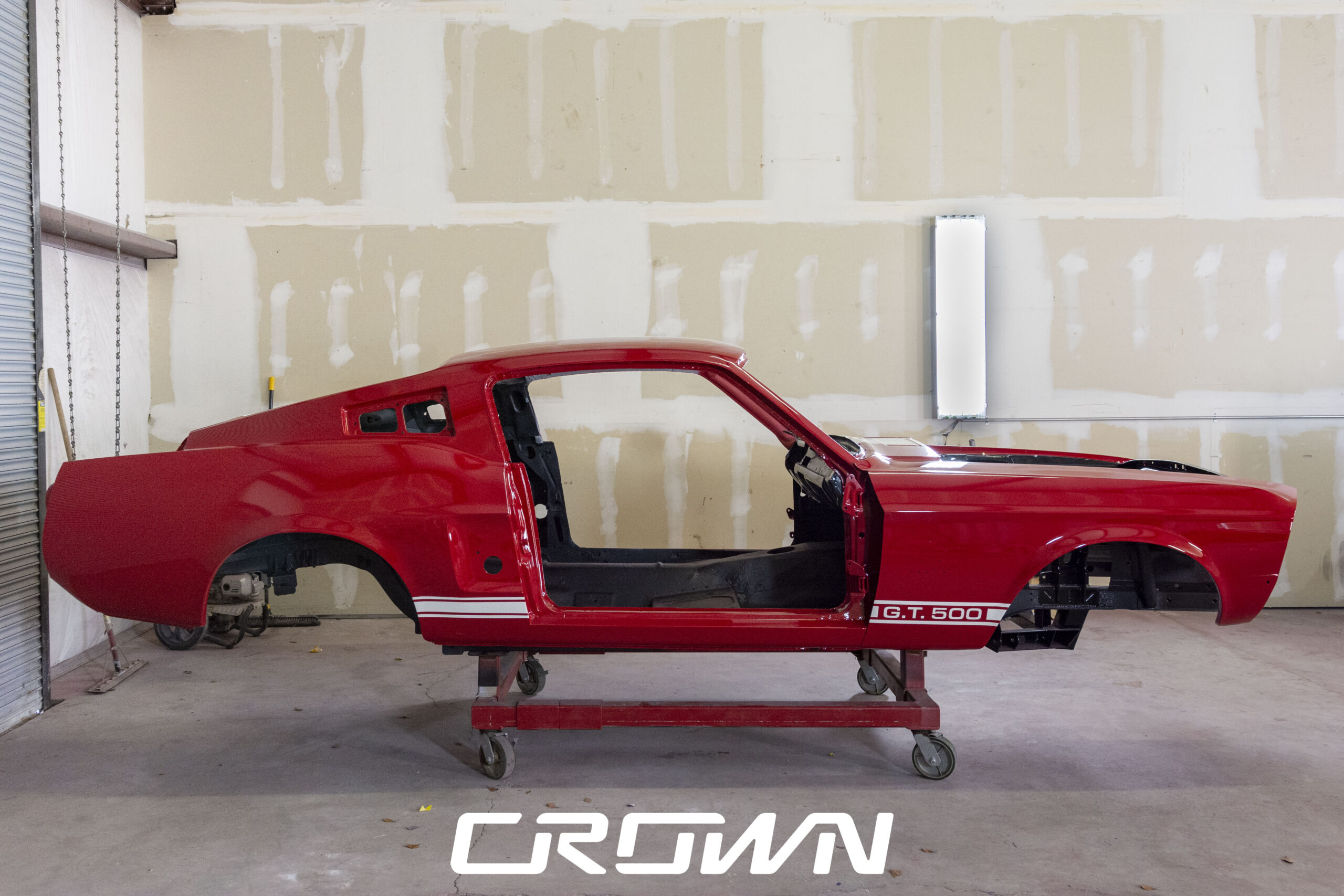
There is a moment in every repaint when I stop being useful. The shell is in the booth, the panel is masked, the painter is holding a cup of something that costs more per gallon than my first car did in total, and I am standing off to one side holding a color chip against a fifty-year-old fender like a man trying to match a sock in a dark closet.
The chip says the color is correct. The fender says it is not. The maddening part, which took me an embarrassing number of years to accept, is that both of them are telling the truth.
I finally went looking for why. What I found was not a paint problem. It was a history problem. The stuff we spray today and the stuff that left Dearborn in 1967 are not the same material, are not applied the same way, and do not throw light back at your eye the same way. A color code is a recipe. It is not a photograph.
Three Weeks to Dry
Start at the beginning, because the beginning explains the hurry.
Before the 1920s, a car was painted more or less the way a carriage was painted, which is to say slowly and by hand. Coats of varnish went on with a brush, and each one had to cure, and then be rubbed down, and then be followed by another. A good finish could take the better part of a month. This was fine when you built a few thousand cars a year for people who were prepared to wait.
It was a catastrophe on a moving assembly line. Henry Ford’s famous line about any color so long as it is black was not a design philosophy. It was a scheduling decision. The black enamels of the day dried fastest, and on a line measured in minutes, drying time was the whole argument.
Two footnotes to that famous quote, both of which I enjoy more than I should. The first is that it was not true for most of the Model T’s life. Early cars, from 1908 into about 1913, could be had in reds and greens and blues and greys. Black arrived when volume did, stayed for roughly a decade, and then the colors came back once the industry solved drying. The second is that Ford did not use one black. It used a whole family of them, chosen for how fast a given part needed to be dry and how it was being handled down the line. Even the least glamorous color in history turns out to have been a range.
Then in 1923 DuPont put a nitrocellulose lacquer called Duco on an Oakland, in a shade called True Blue, and the month became a day. That is not a small improvement. That is the kind of improvement that reorganizes an industry. Suddenly a manufacturer could offer colors, plural, without wrecking production, and the American car stopped being furniture and started being a fashion item. Almost everything we now think of as car culture, the two-tones and the model-year colors and the whole idea that you might choose a car because of how it looks in a driveway, descends from a solvent that flashed off quickly.
It is worth pausing on who DuPont was. The company began in 1802 as a gunpowder mill, and nitrocellulose is not a distant relative of explosives, it is a close one. The same chemistry, in other preparations, gave the world guncotton, smokeless powder, and the film stock that made early movie theaters such thrilling places to sit. Your grandfather’s Buick was wearing a cousin of ammunition, and doing it beautifully.
The Lacquer Bargain
Lacquer works by evaporation. You spray a resin dissolved in solvent, the solvent leaves, and what stays behind is the resin. Nothing chemically transforms. That is why lacquer is so forgiving to repair, because a fresh coat partially redissolves the coat underneath and the two become one film. Spot repairs melt in rather than sitting on top.
The price of that convenience is that lacquer never really stops being soluble, and it stays somewhat brittle. It needs many coats, and it does not arrive glossy. It arrives flat and slightly dusty looking, and the gloss has to be cut and rubbed into it by hand. A properly rubbed lacquer job has a depth that people still chase, and anyone who tells you otherwise has not stood in front of a good one.
It also chalks. Give nitrocellulose a decade of sun and it oxidizes on the surface, hazes, and eventually crazes into a fine web of cracks. Every one of us has met a car whose paint you could dull with a thumbnail.
And it blushes. Spray lacquer on a humid day and the solvent flashing off can chill the surface enough to condense moisture into the wet film, which turns it cloudy and white, as though the panel had caught a cold. The fix is a slower reducer, and the older painters I have known could predict the problem by walking outside and standing still for a minute. In Arizona this is rarely our issue. In Ohio in August it is somebody’s whole afternoon.
General Motors stayed loyal to lacquer for a very long time, moving to acrylic lacquer in the mid to late 1950s, which held color better and was less inclined to chalk. But the underlying bargain never changed. Beautiful, repairable, labor hungry, and mortal.
Enamel Argues Back
Enamel took the opposite position. Where lacquer dries, enamel cures. The alkyd enamels that spread through the 1930s cross link as they harden, which means the film knits itself into something tougher and less soluble than what went into the gun. It also flows out glossy on its own, so you are not committing a week to rubbing.
Broadly speaking, and there were plenty of exceptions, General Motors leaned lacquer while Ford and Chrysler leaned enamel. That divide is worth knowing if you own an old car, because it means two vehicles built the same year in the same country can want completely different things from you.
Enamel’s weakness was repair. Because the film has chemically set, a new coat does not melt into it. It lies on top. Blend a spot repair badly in enamel and you can see exactly where you stopped, forever. Enamel is also slower to dry through, and in the era before modern booths that meant more dust, more time, and more chances for something in the shop to land in your paint.
The Candy Years
Now the fun part, which is also where a piece of very durable confusion enters the story.
In the mid 1950s a California customizer named Joe Bailon worked out how to build a finish in layers that were not opaque. Lay down a bright metallic base, usually gold or silver. Spray a translucent tinted layer over it. Then clear. Light no longer stops at the surface. It travels down through the tinted layer, strikes the metallic underneath, and comes back up through the tint a second time. The color appears to be happening some distance below the surface, because it is.
Bailon called his version Candy Apple Red, and it went through the custom world like weather. Candy finishes are hard to spray, unforgiving of a heavy hand, and nearly impossible to repair invisibly, because the color depends on how many passes you laid down. Two extra coats in one area and that area is simply a different color. There is no fixing it with polish.
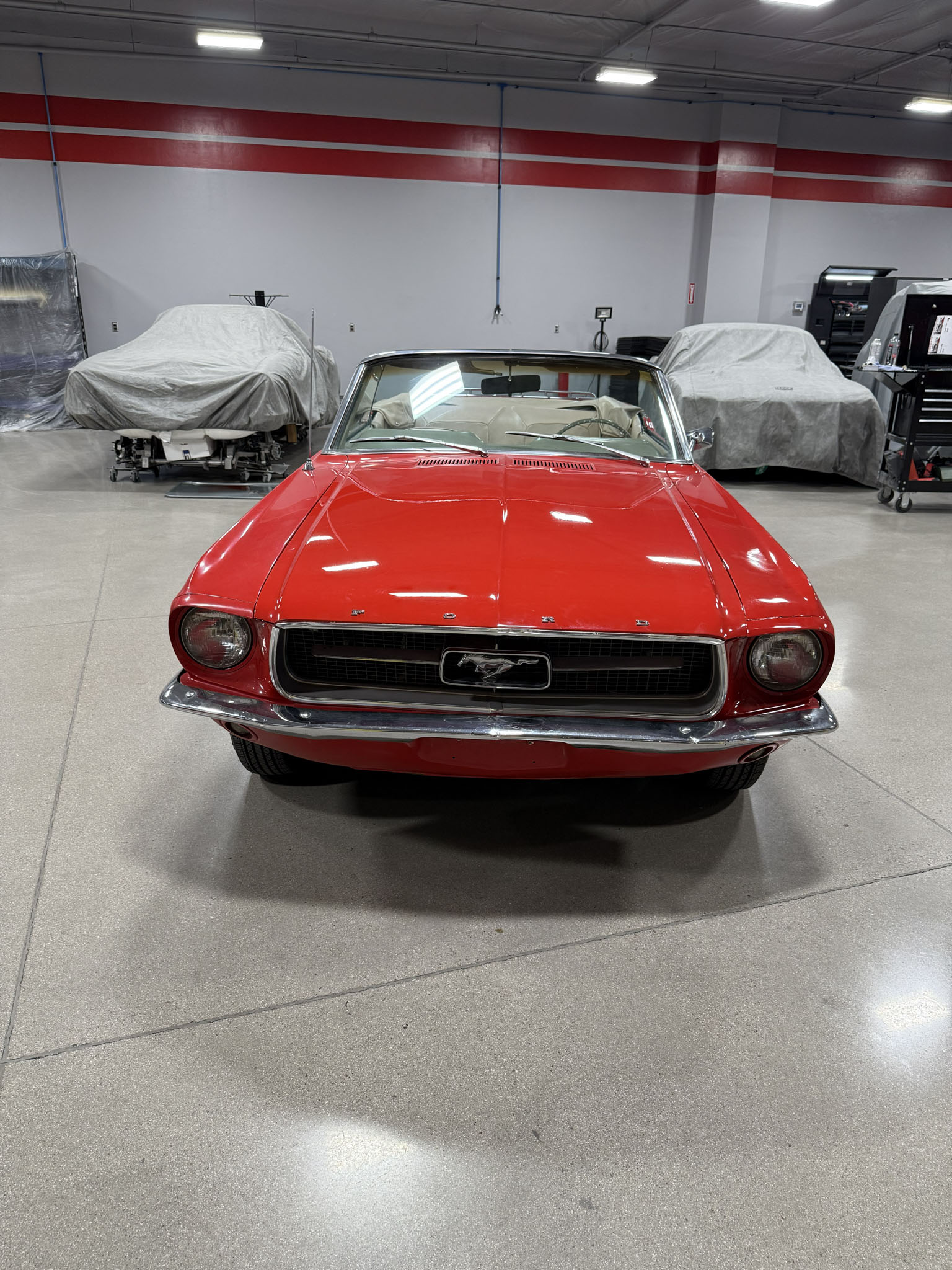
Here is the confusion. Ford later offered a factory color called Candyapple Red, paint code T, on Mustangs in the late 1960s. It is a beautiful color. It is not a candy. It is an opaque, single stage red that borrowed a famous name from the custom world, the way a diner borrows the word bistro. So when someone tells me their car is candy apple red, my first question is always which kind they mean, and I try to ask it without sounding like the sort of person who corrects people at parties. I usually fail.
Eight Things That Sound Made Up
Every trade collects strange true facts the way a shop floor collects washers. Here are the ones I find myself repeating.
One. The shimmer in the first pearl finishes came from fish. The cosmetics industry had long made a material called essence d’Orient by extracting guanine crystals from herring scales, and that is where early pearlescent paint got its trick. Modern pearls use mica flakes coated in titanium dioxide, which is more consistent, more durable, and considerably less interesting at a dinner party.
Two. A concours judge can penalize you for paint that is too good. Factory finishes had a faint texture, the gentle dimpling we call orange peel, because that is what production spray equipment produced. Sand and buff a restoration to a mirror and, in the classes that judge originality, you have moved away from correct rather than toward it. Some of the best restoration shops in the country deliberately reproduce orange peel. It is the only trade I know where the craftsman’s job is to be slightly worse on purpose.
Three. You can measure a car’s history with a magnet-and-meter gadget that fits in a pocket. A paint depth gauge reads total film thickness, and a factory finish typically runs somewhere around four to six thousandths of an inch. Find a door reading three times that and you have found bodywork. Anyone who buys collector cars at auction owns one of these, and the good ones walk the whole car taking readings before they ever look at the interior.
Four. Some period colors genuinely cannot be reproduced, because the pigments are banned. The brightest historic yellows and oranges relied on lead chromate, and some reds on cadmium. Modern substitutes get impressively close, but there are a handful of factory colors where a restorer’s honest answer is that we can get within a whisker and no further.
Five. Van Gogh had the same problem you do. The chrome yellow in his sunflower paintings is lead chromate, the same pigment family that made those unrepeatable car colors, and it has been quietly browning for a century. Conservators study its degradation with equipment that would not look out of place in a paint lab. Pigment does not care whether it is on canvas or a fender.
Six. Nitrocellulose lacquer, movie film, and smokeless gunpowder are all the same chemistry wearing different hats. This is why old film archives are stored so carefully, and why a 1930s paint shop was a more exciting workplace than the job title suggested.
Seven. The best story in the history of racing paint is probably not true. The legend says that in 1934 a Mercedes was a kilogram over the weight limit, so the team scraped the white paint off overnight, revealed bare aluminium, and gave the world the Silver Arrows. Historians have been picking at it for years, and the evidence is thin. I love it anyway, and I mention it here mostly so you can be the person at the show who knows it is disputed.
Eight. Paint is heavy enough to matter. A full repaint on a large car adds real weight, which is why race teams have always been interested in how little of it they can get away with, and why exposed carbon fibre became fashionable partly for reasons that had nothing to do with fashion.
Basecoat, Clear, and the Regulators
The system almost everything wears today separates the two jobs that paint used to do at once. A basecoat carries the color and the metallic or pearl, and does very little else. It goes on thin and dries flat. Then clear goes over the top, and the clear is the part that provides the gloss, the depth, and the resistance to sun and stones and the guy who leans on your fender at a show.
Separating those jobs is genuinely clever, because each layer can now be optimized for one task. It is also why modern paint lasts so much longer than anything from the lacquer era, and why the failure mode changed. Old paint chalked and crazed. Modern paint delaminates, and clear peels off in sheets like a bad sunburn, usually because the film underneath was contaminated or the clear was starved.

The chemistry that made this work is urethane, and urethane comes with a hardener, and those hardeners contain isocyanates. This is the point where painting stopped being a trade you could practice in an open shed with a paper mask. Isocyanates are a serious respiratory hazard, and doing this properly requires a supplied air respirator and a booth that moves real volumes of air. Anyone spraying modern two part material without that is gambling with something they cannot get back.
Then came the regulators, and I say that without sarcasm, because they were right. Solvent based paint puts enormous quantities of volatile organic compounds into the air. California moved first and hardest, the federal rules followed, and the industry reformulated toward waterborne basecoats. Painters grumbled, learned the new material, and largely came around. Waterborne lays down beautifully. It is fussier about airflow and humidity, which in Arizona is a different set of problems than it is in Ohio, but it works.
Why Matching Is Harder Than the Code Suggests
All of which brings me back to standing in the booth losing an argument with a fender.
A factory color code is a formula. It tells you the proportions of tints that produced that color, in that manufacturer’s paint system, in that year. Three things about that sentence cause all the trouble.
First, that paint system no longer exists. The binder is different. The solvents are different. The tints themselves have been reformulated, some of them because the originals contained lead or chromate and are not coming back. You are reproducing a recipe with substituted ingredients and hoping the cake tastes the same.
Second, if there is metallic in it, the code cannot tell you how the flake will lie. Flake orientation depends on how the paint was atomized, how wet it went on, how far the gun was held from the panel, and how fast the solvent left. Modern flake is often finer and more uniform than what a factory sprayed in 1967. Fine flake reads tighter and brighter. Coarse flake reads sparkier and darker at an angle. Same formula, different car.
Third, the original has been aging for fifty years. Ultraviolet light does not fade a color evenly. It attacks some pigments faster than others, so a red does not simply become a lighter red, it shifts in hue as its least stable pigment gives up first. The panel you are matching is no longer the color the code describes. It is the color the code describes, minus half a century.
Layered on top of all this is metamerism, which is the reason a match can look perfect in the booth and wrong in the parking lot. Two colors built from different pigments can reflect identically under one light source and differently under another. Fluorescent light in the shop, sun in the driveway, sodium light in a hotel lot. Match under one and you have not matched under the others.

What It Means in the Booth
Once you accept that the code is a starting point and not an answer, the process stops being frustrating and starts being methodical.
You spray out test cards, several of them, varying the gun distance and the wetness, because on a metallic those variables move the color as much as the mix does. You look at them against the actual car, outdoors, in daylight, not under the booth lights. You let them dry completely, because most colors shift as they flash off and judging a wet card is a good way to talk yourself into a mistake. Then you tint from there, in small increments, and you spray another card.

And when a panel still will not agree, you blend rather than butt the repair. You carry the new color out into the adjacent panel and let it fade into the old, so the eye never gets a hard edge to compare across. Blending is not cheating. It is an acknowledgment that human vision is very good at detecting boundaries and quite poor at detecting gradual change, and that you may as well use that to your advantage.
None of this is glamorous, and none of it shows up in photographs of the finished car. It is a lot of standing in a parking lot holding pieces of cardboard. But it is the difference between a car that looks repainted and a car that just looks right, and nobody has ever found a shortcut around it that survived contact with sunlight.
Automotive Paint FAQ
Why does my new paint not match the original color code?
A color code specifies a mixing formula in a paint system that no longer exists. Binders, solvents, and several original tints have been reformulated or discontinued. On metallics, the code also cannot specify how the flake will lie, which depends on spray technique. The original panel has additionally shifted in hue from ultraviolet exposure.
What is the difference between lacquer and enamel?
Lacquer dries by solvent evaporation and stays soluble, so repairs melt into existing coats, but it needs many coats, must be rubbed to gloss, and eventually chalks and crazes. Enamel cures chemically into a tougher film that flows out glossy on its own, but it does not accept spot repairs as invisibly and dries more slowly.
Is Candyapple Red a candy finish?
Not as Ford used the name. A true candy is a translucent tinted layer over a metallic base, so light passes through the color twice and the hue appears to sit below the surface. Ford’s factory Candyapple Red of the late 1960s, paint code T, is an opaque single stage color that borrowed the name from the custom world.
Why would a judge penalize paint for being too smooth?
Because factory paint had a slight texture known as orange peel. In classes judged on originality, a mirror finish is further from the way the car left the plant than a correctly textured one, so shops restoring to factory specification sometimes reproduce that texture deliberately.
What does a paint depth gauge tell you?
It reads total film thickness. A factory finish generally measures around four to six thousandths of an inch, so readings well above that indicate filler or a repaint. Walking a whole car with a gauge is a standard first step when inspecting a collector vehicle.
Why do shops spray test cards instead of just mixing the code?
Because on metallic and pearl colors the application changes the color. Gun distance, film thickness, and how wet the coat goes on all alter flake orientation, and flake orientation alters what your eye receives. Cards let a painter see the actual result and tint toward the car rather than toward the formula.